Safety Spotlight:
Arc Flash vs. ShockWhat apprentices confuse most and the quick correction
Eric W. Rogers
March 2026 · 7 min read
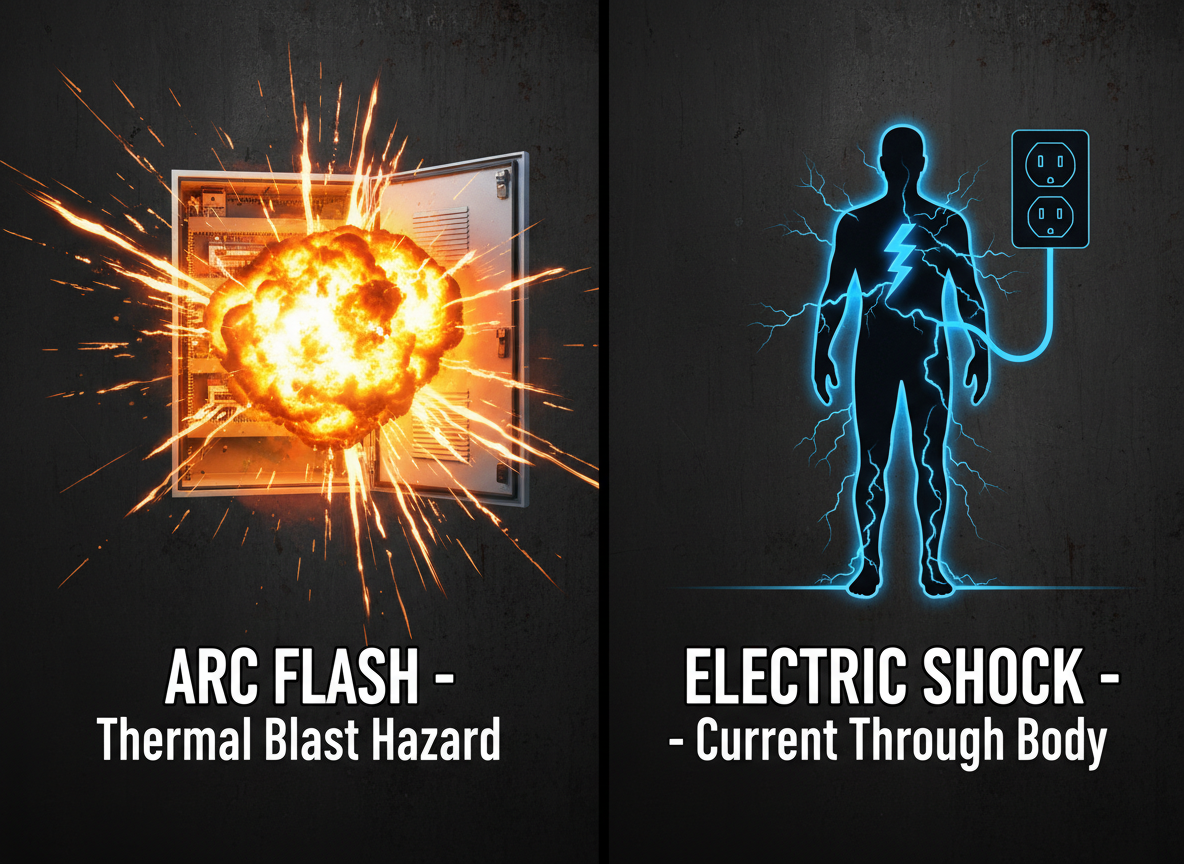
Arc flash and electric shock get lumped together a lot, but they are not the same hazard. If you can separate them in your mind, you will make better decisions about approach boundaries, PPE, and how you set up the job before you ever touch a tool.
The simple difference
Electric shock
A current-through-the-body hazard. It happens when your body becomes part of the circuit.
Arc flash
A thermal blast hazard. A rapid release of energy from an electrical arc that can create extreme heat, pressure, and flying molten metal.
You can have one without the other, and you can have both at the same time.
What apprentices confuse most
Confusion
If I'm wearing rubber gloves, I'm safe from everything.
Correction
Rubber insulating gloves help with shock protection. Arc flash protection is about thermal energy (arc-rated clothing, face shield/hood, etc.).
Confusion
Arc flash only happens on high voltage.
Correction
Arc flash risk depends on available fault current, clearing time, and working distance -- not just voltage.
Confusion
If the breaker is off, there's no risk.
Correction
You still have to verify absence of voltage, confirm the right disconnect, and control stored energy/backfeed. Mistakes happen during troubleshooting and switching.
Confusion
Shock is the main danger; arc flash is rare.
Correction
Shock can kill silently. Arc flash can cause severe burns instantly. Treat both as real, plan for both.
Mini Quiz — Test Your Knowledge
Select your answer for each question, then click Reveal Answers.
1. Per the 2026 NEC and NFPA 70E, which hazard is defined by current passing through the body?
2. True or false: Under the 2026 NEC, arc flash only happens on high-voltage equipment.
3. According to the 2026 NEC and NFPA 70E, rubber insulating gloves primarily protect you from:
4. You can experience arc flash without electric shock.
5. Per the NFPA 70E, which of the following is an arc flash control — not a shock control?
A practical way to think about it on the job
Before you start:
- Identify the task (troubleshooting live? verifying de-energized? racking a breaker? opening a panel?).
- Ask two separate questions:Shock: How could current get through my body?Arc flash: How could an arc start, and how bad would it be?
- Match controls to the hazard:Shock controls: correct boundaries, insulated tools, insulating gloves, verification stepsArc flash controls: arc-rated PPE, keeping distance, reducing exposure time, proper switching practices
The Bottom Line
Arc flash and electric shock are two separate hazards that require two separate sets of controls. Treating them as the same thing is one of the most common — and most dangerous — mistakes in the field. Know the difference before you open the panel.
Shock Hazard
Current through the body
Control with: insulated tools, rubber gloves, approach boundaries, and verified absence of voltage.
Arc Flash Hazard
Thermal blast and pressure wave
Control with: arc-rated PPE, face shield or arc flash hood, distance, and minimizing exposure time.
Plan for both on every energized task. One set of controls does not cover the other.
Contact Us
Questions about training, partnerships, or resource requests? Drop us a message.
Ready to take your skills
to the next level?
Join 1,400+ electricians and students learning for free on YouTube. New lessons every week.