
Quiet Don't Mean Safe: Lockout/Tagout
Eric W. Rogers
April 2026 · 8 min read
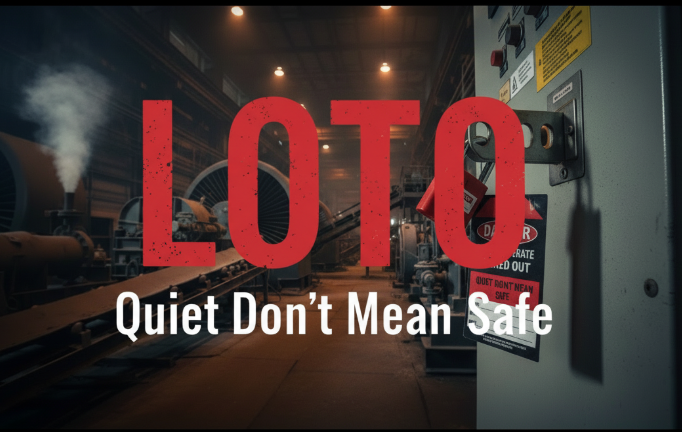
Quiet doesn't mean safe—that's what made it dangerous.
Marcus had been working in industrial maintenance for three years, and he'd learned to trust his instincts. The facility was running smoothly, and the morning shift had just ended. A pump motor needed its bearing replaced—a routine job he'd done dozens of times. The breaker was off. The lock was on. The tag was there. Everything looked safe.
But quiet doesn't mean safe.
LOTO is not about speed. It's not about paperwork. It's about one thing: stopping energy from coming back to life while someone is in the line of fire. Because machines don't give warnings. They start, move, and release stored energy without asking.
And that energy isn't just electrical.
It's pressure in a line.
Tension in a spring.
A suspended load.
Heat, motion, stored force — all waiting.
If it can move, push, drop, spin, or shock… it can hurt you.
That's why only authorized employees touch the locks. They're trained. They know the sequence. They own that lock. Everyone else respects it — no exceptions.
When does LOTO apply?
LOTO isn't for “big jobs only.” It applies anytime something could start up or release energy while you're working. Quick fix, adjustment, inspection — it doesn't matter. If there's risk, there's LOTO.
There is one narrow exception — minor, routine work during production with proper alternative protection in place. But that's not a shortcut. That's controlled, specific, and rare.
Key takeaway
Because the moment you treat LOTO like a suggestion…
…that's when the machine decides otherwise.
Mini Quiz 1 — LOTO Fundamentals
Select your answer for each question, then click Reveal Answers.
1. What is the main purpose of Lockout/Tagout (LOTO)?
2. Which of the following is NOT a type of hazardous energy?
3. Who is responsible for applying and removing lockout/tagout devices?
4. When does LOTO apply during servicing or maintenance?
5. What is one exception to using full LOTO procedures?
As Marcus reached toward the motor coupling, a coworker called out: “Did you verify zero energy?” The question stopped him cold. He hadn't. He'd assumed—and assumptions kill.
The machine didn't fail.
The program did.
Because Lockout/Tagout isn't just something you “do” — it's something you build. And if that foundation is weak, everything on top of it is at risk.
A real energy control program stands on three things
Written Procedures
No paperwork? People guess.
Training
No training? People assume.
Inspections
No inspections? People drift.
That's how accidents happen — not all at once, but slowly, when standards start slipping.
Where most people get it wrong
There is no “one-size-fits-all” procedure.
Every machine is different. Different energy sources. Different isolation points. Different risks. If your procedure isn't written for that exact piece of equipment — it's not good enough.
LOTO isn't generic. It's specific. Every time.
And those procedures must walk the full path:
Shut it down.
Isolate it.
Lock it out.
Verify it.
Release it safely.
Miss a step… and you're trusting luck instead of process.
The part most people overlook
Training is not a one-time event.
The moment something changes — new equipment, new job role, new hazard — the training has to change with it. If the worker doesn't understand it, the program is already broken.
And even if everything looks right on paper…
You still check it.
At least once a year, someone else — not the person doing the work — verifies that the procedure is being followed correctly. Not assumed. Not guessed. Proven.
Because LOTO doesn't fail in theory.
It fails in execution.
Mini Quiz 2 — Energy Control Programs
Select your answer for each question, then click Reveal Answers.
1. Which of the following are core components of an energy control program?
2. Energy control procedures must be specific to:
3. Which of the following must energy control procedures include?
4. When is retraining required?
5. How often must periodic inspections of the program be conducted?
That moment changed how Marcus approached every job. He learned that lockout/tagout isn't just about turning things off; it's about proving they're off. It's about following a procedure, every time, no shortcuts.
The machine isn't loud when it's dangerous.
It's quiet.
Still.
Waiting.
That's what fools people.
They see silence and think safe.
They see “off” and think done.
But energy doesn't disappear — it hides.
In a charged line.
In a pressurized system.
In a load that hasn't dropped yet.
And all it takes… is one mistake.
One switch.
One valve.
One person who didn't know.
That's the difference Lockout/Tagout makes.
It doesn't trust silence.
It doesn't trust assumptions.
It puts control back in your hands — physically, visibly, and personally.
The Bottom Line
Lockout/Tagout is not a bureaucratic procedure. It is the difference between going home and not going home. Every guy who has ever been hurt doing maintenance work thought it was safe. The machine was quiet. Nothing was moving. That was enough.
The 8-step LOTO procedure — know it cold
Notify Affected Employees
Tell everyone who works on or near the equipment that LOTO is being applied
Identify All Energy Sources
Electrical, pneumatic, hydraulic, mechanical, thermal, gravitational
Shut Down the Equipment
Use the normal stopping procedure — follow the written procedure
Isolate All Energy Sources
Open disconnects, close valves, block moving parts — every source
Apply Your Lock
Your lock. Not someone else's. One lock per authorized employee
Release Stored Energy
Bleed pressure, discharge capacitors, block gravity loads, release spring tension
Verify Zero Energy State
Try to start it. Check voltage. Verify pressure is zero. Confirm it is safe
Perform the Work
Now — and only now — is it controlled. Do the job.
Quiet don't mean safe. Controlled means safe.
Contact Us
Questions about training, partnerships, or resource requests? Drop us a message.
Ready to take your skills
to the next level?
Join 1,400+ electricians and students learning for free on YouTube. New lessons every week.