
NEC 2026 Load Calculations: What Changed and Why It Matters
Eric W. Rogers
March 2026 · 15 min read
The 2026 National Electrical Code (NEC) brings the most significant reorganization and clarification of load calculation rules in decades. If you are an electrician, inspector, engineer, or contractor working on residential or light-commercial projects, this affects you directly.
While many of the underlying calculation concepts will feel familiar, the section numbers have changed, the demand factors have been updated, and several long-standing assumptions have been revised — particularly around dwelling units, electric vehicle charging, and existing services.
Load calculations are not just academic exercises. They determine whether an existing electrical service can support new equipment — or whether a costly upgrade is required. They affect decisions around EV charger installations, heat pump retrofits, generator additions, spas, electric cooking conversions, and panel upgrades. Small differences in how you run the numbers can determine whether a permit gets approved or a full service upgrade is required.
This article is a practical, section-by-section walk-through of the key NEC 2026 load calculation changes — and a detailed educational breakdown of the Tesla Harmonics Standard 2026 Service Calculation Method for a one-family dwelling.
"If you're still using 220, you're already behind."
— Eric W. Rogers, NCCER Certified Instructor
The Key Changes at a Glance
Complete Renumbering: Article 220 → Article 120
Load calculation rules have moved from Article 220 to the new Article 120. Every section reference you've memorized has changed. This is the single biggest structural change — and the one most likely to trip people up on exams and in the field.
125% Continuous Load Multiplier Removed
The familiar 125% multiplier for continuous loads has been removed from load calculations. This simplifies the math and eliminates a common source of confusion — but you need to understand why it was removed and where it still applies (hint: it moved to equipment sizing, not load calcs).
General Lighting Load: 3 VA/ft² → 2 VA/ft²
The general lighting load for dwelling units has been reduced from 3 VA per square foot to 2 VA per square foot (NEC 120.41). This reflects modern LED lighting and more efficient fixtures — and it directly reduces calculated service loads.
EV Supply Equipment (EVSE) — More Favorable Treatment
NEC 2026 provides more favorable demand factor treatment for EV charger loads (NEC 120.57). This is significant for residential projects where adding an EV charger previously pushed the service calculation over the limit.
Power Control Systems (PCS) Formally Recognized
Power control systems — devices that dynamically manage and limit loads — are now formally recognized as a distinct concept in the NEC. This allows dynamic load control to be factored into calculations, opening the door for smarter, more efficient service sizing.
Expanded Demand Factors for Existing Dwelling Retrofits
New demand factor allowances make it easier to add loads to existing services without triggering a full service upgrade. For example: 80% for new EVSE and central electric resistance heating, 50% for other new loads. Removed loads can also be subtracted when evaluating capacity.
Simplified Motor & A/C Coincident Load Rules
The rules for handling coincident loads — motors, heating, and air conditioning that don't run simultaneously — have been simplified and clarified in NEC 120.6. Easier to apply, less room for interpretation errors.
Branch-Circuit Load Calculations for Dwellings
A dedicated section now addresses branch-circuit load calculations for dwelling units, using 3 VA/ft² for required circuits (NEC 120.13). This separates branch-circuit sizing from service/feeder calculations — an important distinction.
2026 Service Calculation Worksheet
One-Family Dwelling — Standard Method per NEC Article 120. Each line explained in the context of the new 2026 requirements.
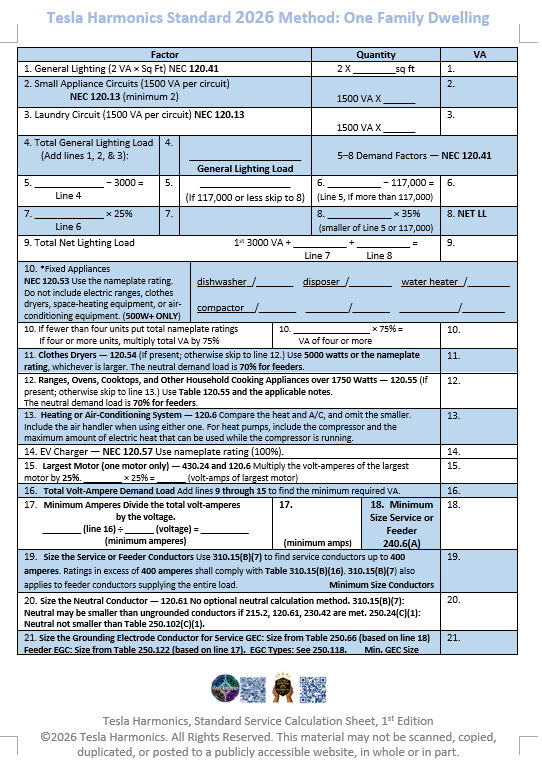
Tesla Harmonics Standard Service Calculation Sheet, 1st Edition — ©2026 Tesla Harmonics. All Rights Reserved.
General Lighting Load
NEC 120.41
Square footage of dwelling × 2 VA/ft² = General Lighting VA
This is one of the biggest changes. The 2023 NEC used 3 VA per square foot. The 2026 NEC reduces this to 2 VA per square foot for dwelling unit general lighting loads. This reflects the widespread adoption of LED lighting and more efficient fixtures. The result: lower calculated loads across the board for residential services.
Use the finished square footage of the dwelling — do not include open porches, garages, or unfinished spaces unless they are adaptable for future use.
Small Appliance & Laundry Circuits
NEC 120.13
Small appliance circuits: minimum 2 × 1,500 VA = 3,000 VA
Laundry circuit: 1 × 1,500 VA = 1,500 VA
Every dwelling unit requires a minimum of two 20-amp small appliance branch circuits serving kitchen, dining, pantry, and similar areas. Each is calculated at 1,500 VA. The laundry circuit is also calculated at 1,500 VA. These values have not changed from previous code cycles — but the section reference has moved to NEC 120.13.
Apply Demand Factors to General Lighting + Small Appliance + Laundry
NEC Table 120.42
First 3,000 VA at 100%
3,001 VA to 120,000 VA at 35%
Remainder over 120,000 VA at 25%
Add the general lighting VA, small appliance VA, and laundry VA together. Then apply the demand factors from Table 120.42. The first 3,000 VA is taken at 100%. Everything from 3,001 VA to 120,000 VA is taken at 35%. Anything over 120,000 VA is taken at 25%.
This demand factor table recognizes that not all lights and receptacles in a dwelling are used simultaneously. It significantly reduces the calculated load compared to the raw VA total.
Fixed Appliances
NEC 120.53
List each fixed appliance at its nameplate rating
If 4 or more fixed appliances → apply 75% demand factor
Fixed appliances include items like dishwashers, garbage disposals, water heaters, trash compactors, and similar permanently installed equipment. List each at its nameplate VA rating. If you have four or more fixed appliances (not including ranges, dryers, A/C, or space heating), you can apply a 75% demand factor to the total.
Dryers
NEC 120.54
Use nameplate rating or 5,000 VA minimum, whichever is greater
For a single dwelling unit, use the nameplate rating of the dryer or 5,000 VA, whichever is larger. The section reference has moved to NEC 120.54. The rules for dryers have been clarified and simplified in the 2026 edition.
Cooking Appliances (Ranges, Ovens, Cooktops)
NEC 120.55 / Table 120.55
Apply demand factors per Table 120.55
Single range ≤ 12 kW: maximum demand = 8,000 VA
Cooking appliance demand factors are now found in NEC 120.55 and Table 120.55. For a single household range rated 12 kW or less, the maximum demand is 8,000 VA (8 kW). For ranges over 12 kW, column adjustments apply. The rules have been clarified and the table simplified compared to previous editions.
Heating and Air Conditioning
NEC 120.6
Use the larger of heating or A/C — not both
A/C: nameplate VA (compressor + fan)
Heating: total connected heating load
The NEC recognizes that heating and air conditioning are non-coincident loads — they do not operate at the same time. You calculate both, then use only the larger of the two in your total demand. This rule has been simplified and clarified in NEC 120.6.
For heat pumps with supplemental electric strip heat, calculate the heat pump compressor load and the strip heat separately. The strip heat is often the larger load and controls the calculation.
Electric Vehicle Supply Equipment (EVSE)
NEC 120.57
EVSE load at nameplate rating
Apply demand factors per NEC 120.57
This is a major win for residential projects. The 2026 NEC provides specific demand factor treatment for EV charger loads under NEC 120.57. Previously, EVSE loads were often calculated at full nameplate with the 125% continuous load multiplier — which frequently pushed residential services over the limit and triggered expensive upgrades.
The new rules recognize that EV charging is a managed, predictable load. Combined with the formal recognition of Power Control Systems (PCS), this opens the door for dynamic load management strategies that can keep existing services viable.
Largest Motor (25% Adder)
NEC 430.24
Add 25% of the largest motor FLA to the total demand
This rule has not changed. The largest motor in the dwelling — typically the A/C compressor — gets an additional 25% of its full-load amperage added to the total demand. This accounts for motor starting current (inrush). Identify the largest motor, calculate 25% of its FLA, convert to VA, and add it to the running total.
Total Demand Load and Minimum Service Size
Total Demand VA = Sum of Steps 3 through 9
Total Amps = Total VA ÷ 240V
Select minimum service size: 100A, 200A, 400A etc.
Add up all the demand loads from the previous steps. Divide the total VA by 240 volts to get the total amperage. Then select the minimum standard service size that meets or exceeds the calculated load. For most modern single-family dwellings, this will be 200 amps — but the calculation proves it.
Conductor Sizing
NEC Table 310.16 / 310.12
Size ungrounded (hot) conductors per calculated ampacity
Size neutral per NEC 220.61 (now 120.61)
Size GEC per NEC Table 250.66
Once you know the service amperage, select conductors from NEC Table 310.16 (or 310.12 for service entrance conductors). The neutral conductor is sized based on the maximum unbalanced load — which is calculated separately. The grounding electrode conductor (GEC) is sized per Table 250.66 based on the size of the largest ungrounded service entrance conductor.
Special Rules for Existing Services
One of the most practical additions in NEC 2026 is the expanded treatment of new loads added to existing dwelling services. Instead of recalculating the entire service from scratch, the code now provides specific demand factors for new loads being added:
This is huge for retrofit work. If a homeowner wants to add an EV charger, heat pump, or spa to an existing 200A service, these new demand factors may prove the existing service has enough capacity — avoiding a $5,000–$15,000 service upgrade.
Mini Quiz — Test Your Knowledge
Select your answer for each question, then click Reveal Answers.
1. Under the 2026 NEC, what is the general lighting load for a dwelling unit?
2. In the 2026 NEC, load calculation rules moved from Article 220 to which new article?
3. Per NEC Table 120.42, what demand factor applies to the general lighting, small appliance, and laundry load from 3,001 VA to 120,000 VA?
4. True or false: The 2026 NEC still requires the 125% continuous load multiplier in load calculations.
5. Under the 2026 NEC, when adding an EV charger to an existing dwelling service, what demand factor can be applied to the new EVSE load?
The Bottom Line
The 2026 NEC did not just rearrange the furniture. It fundamentally updated how we calculate residential electrical loads to reflect modern equipment, modern usage patterns, and modern energy management. Every change points in the same direction: smarter, more accurate calculations that better reflect real-world conditions.
Key changes you must know
Lighting Load Reduced
Dropped from 3 VA/ft² to 2 VA/ft² — reflects modern LED usage
EVSE Demand Factors
NEC 120.57 provides specific demand treatment for EV chargers
PCS Recognition
Power Control Systems formally recognized for dynamic load management
Existing-Service Rules
New demand factors for adding loads without full recalculation
If you are still using 2023 section numbers and assumptions, you are applying the wrong rules. In a code-driven industry, wrong rules mean failed inspections, unnecessary costs, and potential safety issues.
Learn the new code. Apply it correctly. That is the standard.