
2026 NEC Arc Flash Labeling High Impact Changes
Eric W. Rogers
March 2026 · 7 min read
The 1000A rule is gone. Now it's everything.
For years, arc flash labels were treated like a formality. Slap a sticker on the panel, check the box, move on. The 2026 NEC — specifically the updated NEC 110.16 section — just ended that era… New labeling requirements now apply broadly — no amperage threshold, no dwelling exemptions, no vague warnings. If you work on energized equipment, install panels, or inspect electrical systems, this change affects you directly. Here is exactly what changed, why it matters, and what you need to know before it shows up on your next inspection or licensing exam.
What Changed in 2026
- —Required only in limited situations (≥1000A equipment, non-dwelling)
- —Labels could be vague — "Warning: Arc Flash Hazard" was acceptable
- ✓Applies broadly — no 1000A threshold
- ✓System voltage required on label
- ✓Arc flash boundary required
- ✓Incident energy OR PPE level required
- ✓Date of assessment required
Why This Is Huge
You cannot slap a generic warning sticker on a panel anymore. Those days are over. The 2026 NEC requires that arc flash labels reflect actual system data — which means a legitimate arc flash study or documented engineering analysis has to back up every label on every piece of equipment. That study needs to calculate the incident energy at the working distance, establish the arc flash boundary, and determine the appropriate PPE category. No study, no compliant label. No compliant label, no passing inspection.
Missing any of the four required data points — voltage, boundary, incident energy or PPE level, date — is a code violation. Full stop. Inspectors now have clear, specific criteria to check against, and there is no gray area left to argue through. If your label does not have all four elements, the install fails. Get the label right the first time.
As jurisdictions adopt the 2026 NEC, arc flash labeling requirements will appear on journeyman and master electrician exams. Make sure you understand each required label element and why it is there — not just what it is, but how it is used in the field.
Why This Matters in the Field
This change ties directly into NFPA 70E training and PPE selection. The label is no longer just a warning — it is a decision-making tool. Workers use the incident energy value to select the correct arc-rated PPE. If the label is missing that data, the worker cannot make an informed PPE choice. That is the connection between NEC labeling requirements and NFPA 70E compliance that every electrician needs to understand.
Mini Quiz — Test Your Knowledge
Select your answer for each question, then click Reveal Answers.
1. Under the 2026 NEC, which of the following is required on every arc flash label?
2. True or false: The 2026 NEC still uses a 1000A threshold for arc flash labeling.
3. Per the 2026 NEC, what does the arc flash boundary represent?
4. Under the 2026 NEC, a label is missing the incident energy value. What happens at inspection?
5. Why does the 2026 NEC require a date of assessment on every arc flash label?
What a Compliant 2026 Label Looks Like
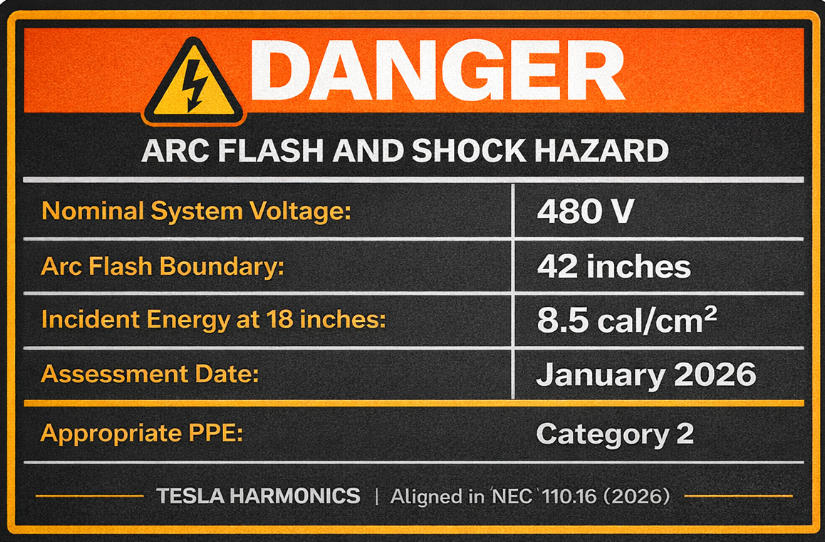
Here is an example of a compliant NEC 2026 arc flash label. Notice all four required elements are present: system voltage (480V), arc flash boundary (42 inches), incident energy (8.5 cal/cm²), and date of assessment (January 2026).
The Bottom Line
The 2026 NEC eliminated the guesswork. A generic warning sticker is no longer enough — every arc flash label must be backed by a real study and include all four required elements. No exceptions, no gray area.
Per NEC 110.16 (2026), every arc flash label must include
System Voltage
Nominal voltage of the system
Arc Flash Boundary
Distance where energy = 1.2 cal/cm²
Incident Energy or PPE Level
cal/cm² value or PPE category
Date of Assessment
When the arc flash study was done
Miss one of these and you're risking a failed inspection. Get them right every time.
Contact Us
Questions about training, partnerships, or resource requests? Drop us a message.
Ready to take your skills
to the next level?
Join 1,400+ electricians and students learning for free on YouTube. New lessons every week.