
GFCI: How It Works and Why It Saves Lives
Eric W. Rogers
March 2026 · 8 min read
If you work in the electrical trades — or even if you just live in a home with electricity — you need to understand what a Ground-Fault Circuit Interrupter (GFCI) is, how it works, and why it exists. It is one of the most important personnel protection devices in the National Electrical Code.
A GFCI is not there to protect your equipment. It is not there to protect the wiring in your walls. It is there to protect you. That distinction matters — and understanding it could save your life.
What Is a GFCI?
According to NEC Article 100, a Ground-Fault Circuit Interrupter is defined as:
"A device intended for the protection of personnel that will de-energize a circuit or portion of circuits when the current to ground exceeds the value of a Class A device (4 mA to 6 mA)."
That 4 to 6 milliamp threshold is critical. Research has shown that currents above 6 mA flowing through the human body can cause involuntary muscle contraction — meaning you may not be able to let go of the energized conductor. Above 30 mA, the risk of ventricular fibrillation and death increases dramatically. The GFCI is designed to act before the current reaches a level that causes serious harm.
How It Works — Step by Step
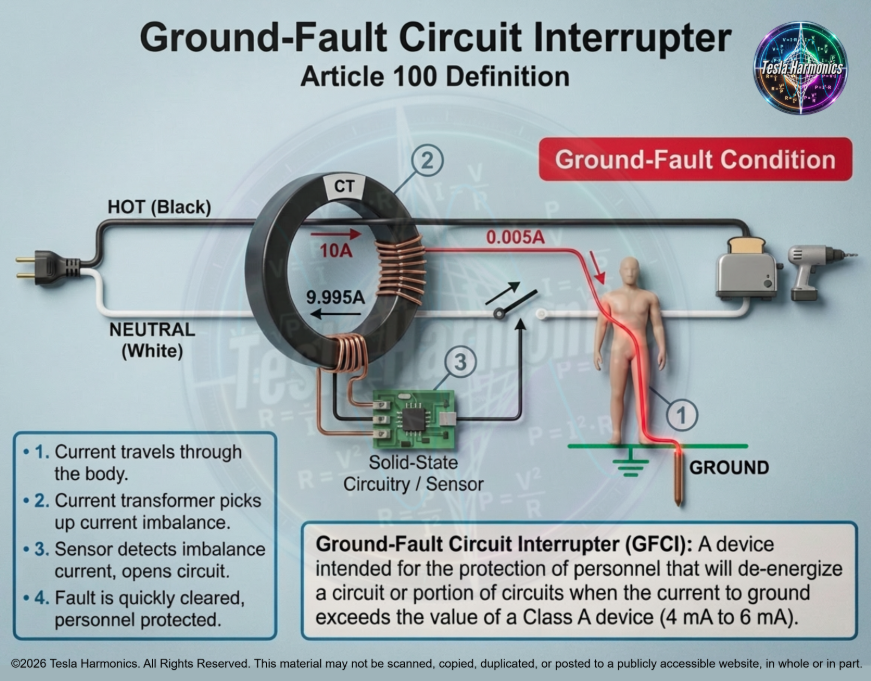
The graphic above shows exactly what happens during a ground-fault condition. Here is a breakdown of each step:
Current Travels Through the Body
In a ground-fault condition, current finds an unintended path to ground — through a person. In the diagram, 10 amps flows out on the hot (black) conductor, but only 9.995 amps returns on the neutral (white). The missing 0.005 amps (5 milliamps) is flowing through the person to ground. That is the fault current.
The Current Transformer Detects the Imbalance
Both the hot and grounded conductors pass through a current transformer (CT). Under normal conditions, the current on the hot equals the current on the grounded conductor — they cancel each other out and the CT sees zero net current. But when there is a ground fault, the current out does not equal the current back. That difference — even as small as 5 milliamps — creates a measurable signal in the CT.
The Sensor Detects the Imbalance and Opens the Circuit
The solid-state circuitry (sensor) connected to the CT picks up that imbalance signal. When the difference reaches the 4–6 mA Class A threshold, the sensor triggers the GFCI to open the circuit — cutting power in as little as 1/40th of a second. The fault is cleared. The person is protected.
Fault Cleared — Personnel Protected
The circuit is de-energized before the current through the body can reach a lethal level. The person may feel a shock — but the GFCI acted fast enough to prevent serious injury or death. That is the entire purpose of this device.
What "Personnel Protection" Really Means
This is the part that trips people up — no pun intended. A GFCI is classified as a personnel protection device. That means its job is to protect people, not property, not equipment, not wiring.
Compare it to other protective devices:
- A circuit breaker protects the wiring from overheating due to overcurrent. It does not react fast enough to protect a person from electrocution.
- A fuse protects the circuit from excessive current. Same limitation — too slow for personnel protection.
- A GFCI protects people. It monitors for current leaking to ground through an unintended path — like a human body — and shuts the circuit down in milliseconds.
This is why the NEC requires GFCI protection in locations where people are most likely to come into contact with water and grounded surfaces — bathrooms, kitchens, garages, outdoors, crawl spaces, unfinished basements, and more. These are the places where the risk of a ground fault through a person is highest.
The NEC has been expanding GFCI requirements with nearly every code cycle. NEC 210.8 now covers more locations and more circuit types than ever before. That expansion is driven by one thing: data. GFCIs save lives. The more places they are required, the fewer electrocution deaths occur.
Mini Quiz — Test Your Knowledge
Select your answer for each question, then click Reveal Answers.
1. Per the 2026 NEC Article 100, what is the trip threshold for a Class A GFCI device?
2. According to the 2026 NEC, a GFCI is classified as which type of protective device?
3. How does a GFCI detect a ground fault?
4. Under the 2026 NEC 210.8, which of the following locations now requires GFCI protection for all 125-volt through 250-volt receptacles?
5. True or false: Under the 2026 NEC, a standard circuit breaker provides the same level of personnel protection as a GFCI.
The Bottom Line
A GFCI does one thing, and it does it exceptionally well: it detects when current is going somewhere it should not — through a person, through water, through a fault path to ground — and it kills the power before that current can kill you.
What you must know cold
4–6 mA Trip Threshold
Class A GFCIs trip at 4–6 milliamps — before current reaches a lethal level
Current Transformer Detection
The CT monitors hot vs. neutral — any imbalance triggers the trip in 1/40th of a second
Personnel Protection Only
GFCIs protect people, not wiring. Breakers and fuses are too slow for electrocution protection
NEC 210.8 Locations
Required in bathrooms, kitchens, garages, outdoors, crawl spaces, and more — expanding every code cycle
If you are an electrician, you need to understand this device inside and out. If you are a homeowner, you need to know that the GFCI outlets in your home are there for a reason — test them monthly, replace them when they fail, and never remove or bypass them.
Personnel protection is not optional. It is the standard.