
7 Types of Electrical Loads
Eric W. Rogers
April 2026 · 7 min read
Learning to “See” the Load
It was one of those lab days where you can tell — before anybody even touches a tool — that the lesson is going to matter out in the real world.
The class was mixed, like it usually is. A couple of brand-new apprentices who still call every device “a motor,” a few DIY folks who can wire a receptacle but want to understand why things behave the way they do, and one student who works maintenance nights and keeps a notebook full of “weird problems” from the plant.
I started the day with a simple question:
“If I tell you something is ‘a load,’ what does that actually mean?”
Somebody answered, “It's what uses power.” That's not wrong. But it's not enough to troubleshoot, design, or even talk clearly with other electricians.
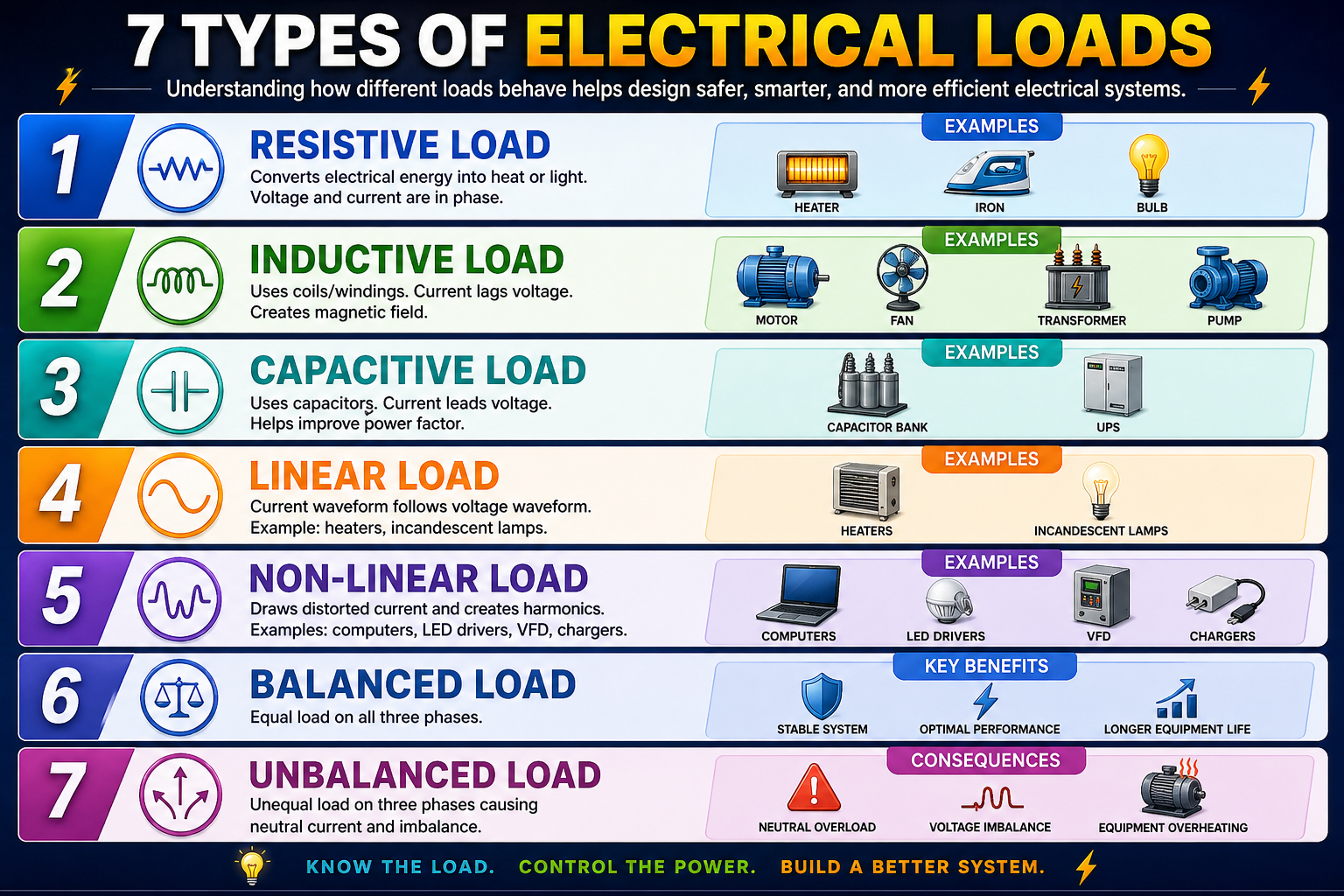
So I pulled up the infographic you just studied: 7 Types of Electrical Loads.
“Today,” I said, “we're going to learn to see the load. Because once you can name what kind of load you're dealing with, you can predict what it's going to do to your circuit — before it does it.”
Mini-Quiz #1 — Identify the load type by example
Choose the best answer for each. Select your answer, then click Reveal Answers.
1. A glowing toaster element is primarily a:
2. A shop air compressor motor is primarily a:
3. A phone charger (the "brick") is most often a:
4. A capacitor bank installed to improve power factor is a:
5. A building with lots of old incandescent lamps is mostly:
Resistive Loads
We began with the easiest category: resistive loads. These convert electrical energy into heat or light, and the key behavior is this: voltage and current are in phase.
Examples are everywhere: space heaters, toaster elements, electric ovens, incandescent bulbs, and simple irons.
Inductive Loads
Then we moved to inductive loads — anything using coils or windings that creates a magnetic field. The key behavior: current lags voltage.
Motors, fans, transformers, pumps, solenoids, and contactor coils live here.
Capacitive Loads
Next: capacitive loads. Capacitors store energy too, but their behavior is the opposite of inductive. Key behavior: current leads voltage. Capacitor banks are also used to help improve power factor.
Linear Loads
Now we shifted from what the device is to how the current behaves. Linear loads draw current that follows the voltage waveform. Classic examples: heaters and incandescent lamps.
Non-Linear Loads
Non-linear loads draw distorted current and can create harmonics. Computers, LED drivers, VFDs, and chargers are common examples — and so are phone chargers, laptop bricks, and modern TVs.
Balanced Loads
A balanced load means equal load on all three phases. Benefits: a stable system, optimal performance, and longer equipment life.
Unbalanced Loads
An unbalanced load means unequal loading across phases, which can create neutral current and imbalance. Consequences include neutral overload, voltage imbalance, and equipment overheating.
Bringing it back to the lab bench
When you can name the load, you can predict behavior. When you can predict behavior, you can design safer systems, troubleshoot faster, and avoid the kind of mistakes that cost time — or worse, hurt someone.
Mini-Quiz #2 — Mixed final check
Choose the best answer for each. Select your answer, then click Reveal Answers.
1. In a resistive load, voltage and current are typically:
2. Which is most likely to create harmonics?
3. A balanced three-phase load generally leads to:
4. Current lags voltage most commonly in:
5. An unbalanced load can cause:
The Bottom Line
Every device on a circuit is a load — but not every load behaves the same way. If you can name the load type, you can predict what it will do to your circuit before it does it. That is the difference between guessing and diagnosing.
7 load types — know them cold
Resistive
Converts energy to heat or light. Voltage and current are in phase.
Inductive
Uses coils and magnetic fields. Current lags voltage.
Capacitive
Stores energy electrically. Current leads voltage.
Linear
Current waveform follows voltage waveform. Clean, predictable behavior.
Non-Linear
Draws distorted current. Creates harmonics. Think VFDs, chargers, LEDs.
Balanced
Equal load across all three phases. Stable, optimal performance.
Unbalanced
Unequal phase loading. Causes neutral current, voltage imbalance, and overheating.
Name the load. Predict the behavior. Troubleshoot faster. Build safer systems.
Contact Us
Questions about training, partnerships, or resource requests? Drop us a message.
Ready to take your skills
to the next level?
Join 1,400+ electricians and students learning for free on YouTube. New lessons every week.